 Русский
  English
  Deutsch
  Español
  العربية
  中文
中文  Türkçe
  Français
  Italiano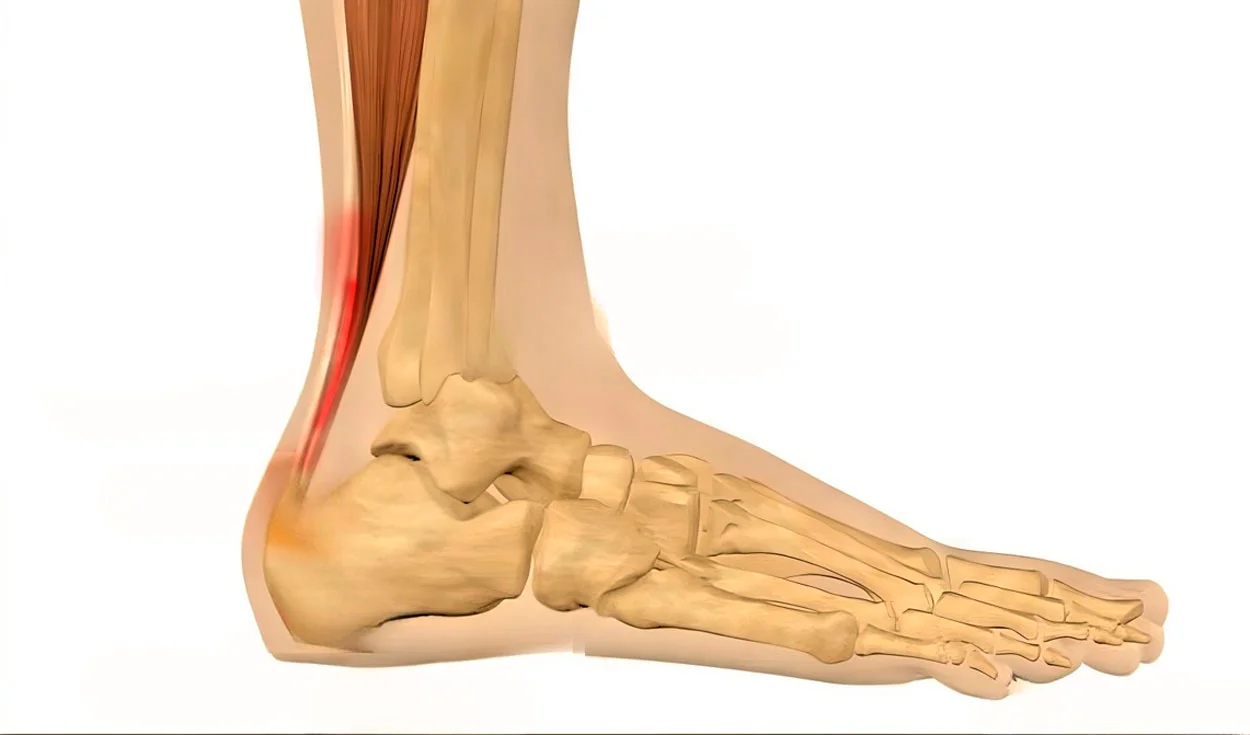
What is Achilles tendinitis?
Achilles tendinitis is inflammation and degeneration of the Achilles tendon, the largest and strongest tendon in the human body. It withstands loads up to 12 times body weight during running, but chronic overload leads to tendinopathy — degeneration of collagen fibers.
Without treatment, tendinopathy progresses and can lead to a complete Achilles tendon rupture — a serious injury requiring surgery and prolonged rehabilitation.
Types of involvement:
- Mid-portion — most common, area of reduced blood supply
- Insertional — at the attachment to the calcaneus, often with calcification
Symptoms:
- Pain in the back of the lower leg above the heel
- Morning stiffness and pain with first steps
- Tendon thickening and swelling
- Pain during running, climbing stairs
- Crepitus with movement
Facts about Achilles tendinitis
- ICD-10: M76.6
- In runners: up to 11% of injuries
- Age: 30-50 years
- Load: up to 12x body weight
- Steroids PROHIBITED: risk of rupture!
How MIBRAR® treats Achilles tendinitis
Ultrasound diagnostics
Sono Control Arm™ visualizes tendon thickening, degeneration zones, neovascularization, partial tears. Determines mid-portion or insertional type.
Obtaining concentrates
CGF — growth factors for stimulating tenogenesis. Lipogems® — stem cells differentiating into tenocytes — tendon tissue cells.
Injection into degeneration zone
Under ultrasound guidance, concentrates are injected into the thickened tendon zone and paratenon. Navigation accuracy prevents tendon damage.
Tendon regeneration
Stem cells synthesize new type I collagen, restoring structure. Growth factors suppress neovascularization (pain source). The tendon strengthens — rupture risk decreases.
MIBRAR® Method Advantages
95% of interventions covered
MIBRAR® covers up to 95% of all spinal neurosurgery and orthopedic operations.
No anesthesia or incisions
Outpatient treatment via 0.3-1.5 mm puncture. No general anesthesia or hospitalization.
No age restrictions
Regeneration at any age. Safe for chronic conditions and anesthesia intolerance.
Rapid improvement
Concentrates have analgesic and anti-inflammatory properties. Relief within days.
Multiple zones at once
Simultaneous treatment of multiple discs or joints in one procedure.
Home the same day
No crutches, braces or rehabilitation needed. MRI follow-up at 8-16 weeks.
MIBRAR® Technology

Cyber Navi Hand™
Intraoperative robotic navigation system. Provides precise access to deep structures with 1 mm and 1 degree accuracy.

Sono Control Arm™
Device for intervention under sonographic control. Eliminates open surgeries with real-time visual monitoring.